How Do I Actually Trust God When Life Feels Out of Control? (Moving From Saying It To Living It)
It’s easy to say “I trust God” when life is going smoothly. When your plans are working out and your prayers are getting answered, trust rolls off the tongue without a second thought. But when life flips upside down. When the job falls through, the diagnosis comes back, or the people you thought were safe suddenly aren’t, those words don’t feel so light anymore. They feel tested. And sometimes, they feel hollow. When the world seems like it’s on the brink of insanity, and you sense God is calling you to fully trust Him, it can feel like the rug is being pulled out from under you. I know, I’ve been there.
WHEN TRUST FEELS LIKE A NICE IDEA, BUT NOT A PLAN
We’re told to trust God with everything. It’s on coffee mugs and bumper stickers and stitched into the throw pillow you didn’t ask for but was the right color and on sale at Hobby Lobby. But what do you do when your mouth says, “God is good,” but life feels out of control, and your insides are quietly panicking? What does real trust look like when you’re standing in the middle of a storm with absolutely no signs of how or when it will end? Or you just feel like you are standing in the middle of the desert, no clue where you are or where you are going?
That’s the question we have to answer honestly, not just with a Bible verse, but with a decision about how we live when we don’t get what we want, don’t see what we hoped for, and don’t feel what we expected. This is trust. Not the “idea” of trust, but the practical, in-your-face kind of trust that requires something more than our daily TikTok devotionals (not judging, just saying).
THE DIFFERENCE BETWEEN BELIEVING GOD AND TRUSTING HIM
Plenty of people believe in God. They believe He’s real. They believe He’s powerful. They believe He’s sovereign. But believing in who God is and trusting Him with your actual life are not the same thing. Hey, even the demons in the New Testament knew Jesus. They even knew what He was capable of doing. But, they didn’t trust Him. It’s the same with so many people who cling to “belief” in Jesus without walking in “faith” with Him. It boils down to, “Do I trust God more than I trust myself?”
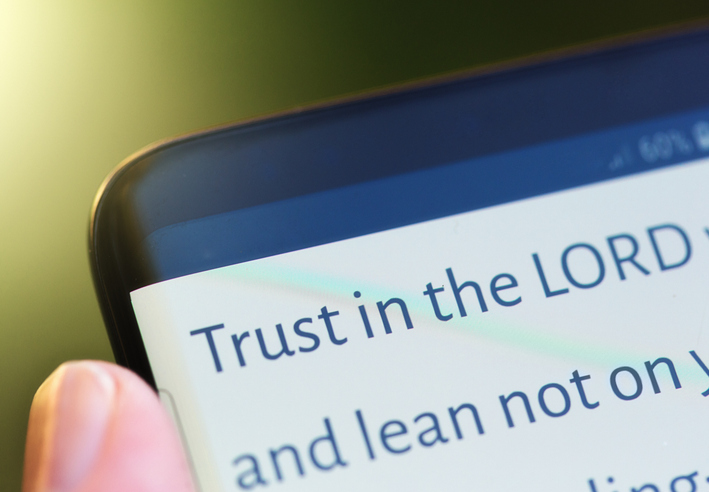
Belief can sit still. Trust moves. Belief nods. Trust obeys. Belief recites verses. Trust holds onto those verses when nothing else in your life makes sense. Scripture doesn’t treat trust like a warm feeling or a default mindset. It’s something you choose. Proverbs 3:5–6 tells us plainly, “Trust in the Lord with all your heart, and do not lean on your own understanding. In all your ways acknowledge him, and he will make straight your paths.” This has always been one of my favorite verses. I memorized this one when I was about 2 years old (honest truth). But for most of my life, I’ve required answers before I trusted God and a clearly seen path before I followed Him. I have to tell you, that didn’t work out so well for me.
I have a feeling you’re not too different than me. You will lean on something. Whether it’s your ability to solve problems, your need for control, your influence on others, your planning, your savings, or your instincts—there’s always something we’re leaning on. God doesn’t just ask us to believe in Him. He asks us to shift our full weight onto Him. He asks us to walk His path without being able to see down the road. And that kind of trust rarely feels natural in the moment. It feels like surrender. Because it is.
REAL TRUST ISN’T EASY, BUT IT’S WORTH IT
Trust doesn’t always come wrapped in a pretty bow of peace at first. That’s one of the hardest truths I’ve had to learn. You can be trusting God every single day and still feel unsettled. You can be obeying and still feel scared out of your mind. The presence of fear doesn’t cancel out your faith. It’s life. It’s just what we humans do sometimes. The trust is in moving forward anyway.
In Psalm 56:3, David writes, “When I am afraid, I put my trust in you.” He doesn’t wait until the fear disappears to declare his trust. He trusts right in the middle of it. That’s what mature faith looks like. It’s not some polished performance for the benefit of others; it’s a persistent surrender in the quiet moments when we are alone with God.
There are times when God will ask you to do something without giving you the details. Abraham walked away from everything familiar without knowing where he was going. The text in Hebrews 11:8 says he “went out, not knowing where he was going.” God didn’t hand him a five-year plan with goals and deliverables. He handed him a promise. And Abraham trusted God enough to pack up everything that he owned and just start walking.
That kind of trust doesn’t happen on your living room sofa. It happens in motion. If you’re waiting to feel confident before you step out, the world and the life God has for you will pass you by. Confidence doesn’t always precede trust. For most people, it follows trust. It’s generally about a half-mile behind, smiling at you like a sarcastic donkey. “You keep him in perfect peace whose mind is stayed on you, because he trusts in you” (Isaiah 26:3). The peace and confidence come after the trust. Not the other way around.
WHAT TRUST LOOKS LIKE ON AN ORDINARY DAY
Trusting God isn’t normally dramatic. It shows up in quiet decisions, behind-the-scenes obedience, and unseen persistence. It’s choosing not to manipulate the outcome, even when you could. It’s praying when you’re tired of praying. It’s forgiving when you don’t feel like it. It’s tithing when your bank has you on speed dial. It’s honoring a commitment even when the reward isn’t immediate or never comes at all. Trust is built in those moments.
If you want to know whether you’re really trusting God, look at your behavior. Are you leaning on your own understanding, or His? Are you adjusting your life around your fear, or around His Word? Are you acting on what you know He’s already told you, even if it’s not yet easy, comfortable, or understood?
SO HOW DO YOU DO THIS TRUST THING, REALLY?
Trust isn’t a feeling you wait for. It’s something you do. And like anything worth doing, it takes practice. These aren’t magic steps or spiritual formulas. But they are intentional ways to put your trust into motion—real-life, day-to-day ways to live like you believe God is who He says He is.
- Practice trusting God out loud: There’s power in naming what you’re trusting God for. Don’t just pray silently—speak it. Say it to God. Say it when you’re afraid. Speak trust into your own doubt. Romans 10:10 reminds us, “For with the heart one believes and is justified, and with the mouth one confesses and is saved.” There is something about voicing truth that anchors it deeper. When you say, “I’m trusting God with this,” you’re practicing faith with purpose.
- Stop rehearsing worst-case scenarios: Fear thrives in imaginary outcomes. Trust stays grounded in what’s true. Jesus asked, “And which of you by being anxious can add a single hour to his span of life?” (Luke 12:25). That question isn’t rhetorical; it’s a gentle redirection from Jesus. If your mental energy is being spent rehearsing every version of what might go wrong, it’s time to invite God into the middle of the situation, not just the resolution. Trust isn’t naive. It’s focused. It says, “God is here, even if nothing changes.”
- Obey without a full explanation: If you know what God has asked of you, through His Word, through conviction, or through wise counsel, then do it. Even when it doesn’t make perfect sense. For me, writing or doing my podcast every week doesn’t make much sense. But I do it anyway, even when it’s inconvenient. Even when no one reads it or listens. Because God didn’t ask me to be instafamous, He asked me to be faithful. Faith without works is dead (James 2:17), and obedience without trust often becomes delayed disobedience. Abraham didn’t know where he was going, but he went (Hebrews 11:8). That’s trust in action. We won’t always have answers, but we can have assurance that God sees the big picture.
- Anchor your memory: When life feels unstable, you need more than vague encouragement or bloggers telling you it’s all going to be alright. You need evidence. Go back and write down how God has shown up before. Rehearse His faithfulness. Psalm 77:11 says, “I will remember the deeds of the Lord; yes, I will remember your wonders of old.” This isn’t a statement of nostalgia here; it’s a discipline. And it trains your heart to see His fingerprints in places you missed the first time. It calls you to look back and see how God was in control all along. He brought you here, but He won’t leave you here.
- Don’t wait until you know the “how:” You are not the solution to your own crisis. And God never asked you to be. Proverbs 16:9 says, “The heart of man plans his way, but the Lord establishes his steps.” Make your plans. Do what you can. But stop trying to be the sovereign Lord of your own life. You’re not called to carry the outcome. You’re called to start moving and see where it leads. It’s scary. But it’s also kind of exciting, too.
YOU DON’T HAVE TO BE READY TO BE FAITHFUL
The beauty of trust is that it’s about surrender. God never asked you to be unshakable. He never said that you had to be the strongest. He doesn’t require you to be the smartest. He only asks you to hold on. He doesn’t measure your trust by how confident you sound in your prayers. He measures it by the posture of your heart when things don’t go according to your plan.
You don’t have to feel ready to be faithful. You just have to be willing. You just have to take that first step, whatever that step looks like to you. The act of trusting God in the middle of uncertainty isn’t a passive decision. It’s holy work. And He honors it.
No one else may ever see your trust and faithfulness. You may never have any acknowledgement this side of heaven. That’s okay. You’re not doing it for accolades or attention. Faithfulness isn’t clickbait. Faithfulness in the work God has called you to do (from setting up chairs in church to being that prayer warrior that stands in the gap for all of us) is between you and God. Never forget that acts of quiet faithfulness are the backbone of the body of Christ.
So when your heart is racing and the future is unclear and nothing you’re holding seems solid anymore, that’s the time to plant your feet. Speak His name. Surrender the outcome. And keep walking like His Word is more reliable than what you see around you. Because the farther you walk, the more you will realize His Word is true.
☕ May you have a little faith, a little courage, and a whole lot of stubborn joy. – Tonya
How have you learned to trust God when nothing feels steady? Drop a comment below. I’d love to hear your story.
© 2025 All posts written (between deep breaths, quiet prayers, and a snoring poodle on my lap) by Tonya E. Lee.